 Qemoravin
Qemoravin
Qemoravin
A single number is a compression of things that do not compress. Below is the whole apparatus: what each band measures, how long we play before we are allowed to write, which machines we test on, and the only three verdicts we permit ourselves.
Each is scored out of one hundred by the writer, then challenged by one other person on the desk before publication.
Whether the thing is well made on its own terms. Does the systems design hold together, is the writing doing work, does the art direction have a point of view? This is the band closest to conventional criticism and the one where our disagreements are most often a matter of taste rather than fact.
Whether hour forty is as interesting as hour four. We can only score this because we finish things. Games that front-load their good ideas score badly here even when they score well above, and this is the band we most often revise downward on a revisit.
Whether a reader with limited hand mobility, low vision, or a need for frequent breaks can actually play it. We test the remaps we can test and print which ones we tried. A menu that lists an option we could not get to work does not count toward this band.
Whether the game does on our machines what its own stated requirements say it will. Crashes, lost saves, dropped inputs and stutter all land here. A brilliant game that eats a save file is still a game that ate a save file.
For anything with an ending, a write-up cannot be published until at least one of us has reached it. No exceptions have been made in seven years, which has cost us every launch-day audience we might otherwise have had.
For games without an ending — simulations, builders, endless roguelikes — we declare an hour count before starting and print it with the piece, along with what we actually spent. When we go over, that is usually worth knowing.
Hours are wall-clock, from a stopwatch on the bench rather than a launcher's count, because launchers keep counting while you make tea.
| Piece | Basis | Declared | Actual |
|---|---|---|---|
| Saltmarch Compact | Has an ending | Credits | 81 h |
| The Pumphouse Year | Has an ending | Credits | 9 h |
| Three Wells | No ending | 50 h | 74 h |
| Lampmoor Drift | Has an ending | Credits | 11 h, unfinished |
| Coppice Rule | No ending | 60 h | 58 h |
| Tidemark Halt | Has an ending | Credits | 11 h |
| Harrowgate Ledger | No ending, revisit | 30 h added | 118 h cumulative |
Lampmoor Drift is the one row where the rule was not satisfied. That is why it carries our third verdict rather than a recommendation.
A larger scale would let us dodge the question. Three forces a decision and makes disagreement visible.
Not that it is flawless — Saltmarch Compact has a genuinely bad diplomacy screen and still carries this verdict. It means the flaws are worth tolerating and we say which ones.
Both positions get printed with names attached. We would rather show you a real argument between four readers than manufacture a consensus none of us holds.
Reserved for technical failure rather than weak design. We send our logs to the studio, print a short piece, and put a real date in the diary to return.
None of this hardware is new. That is the point — a game that only runs well on a machine most readers do not own has not solved the problem.
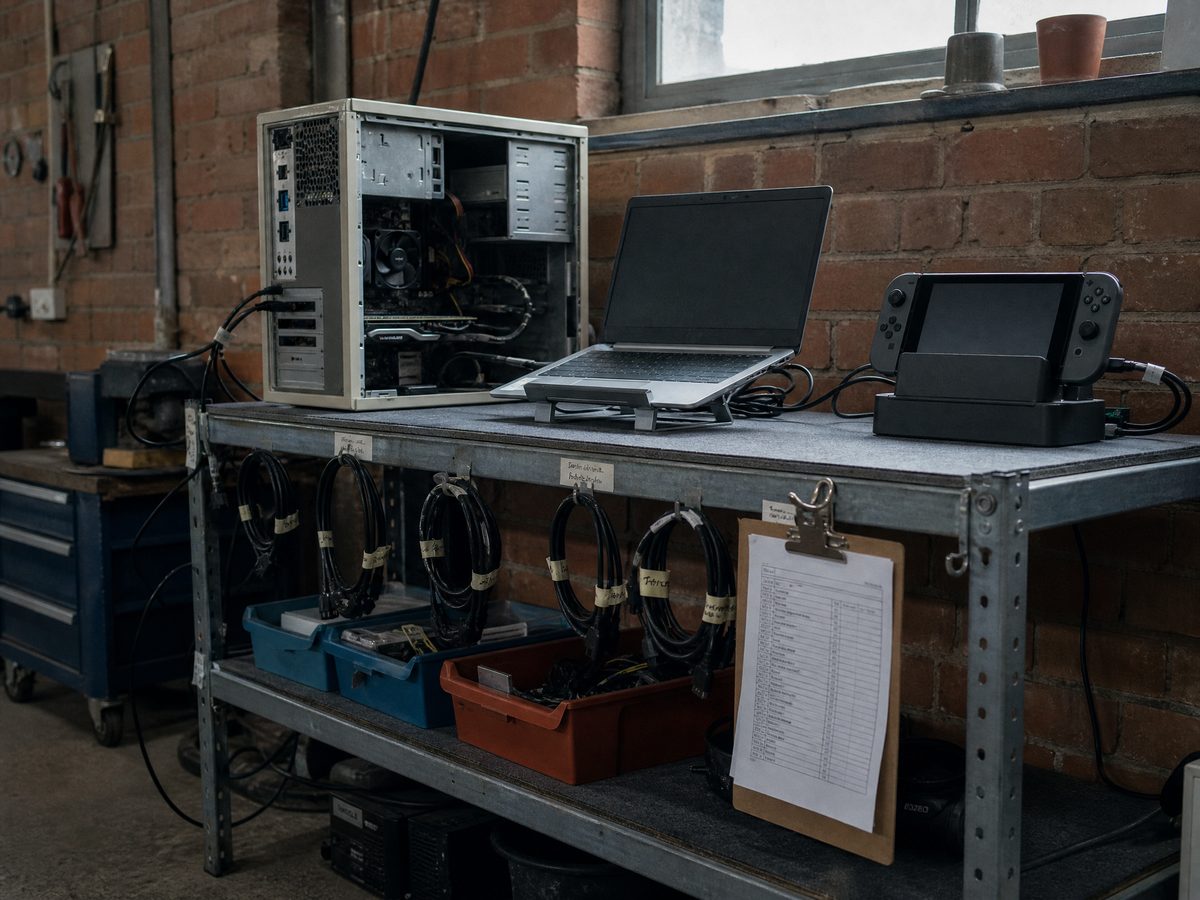
| Machine | Age | What it is for |
|---|---|---|
| Desktop tower | Four years | The upper bound. If a game struggles here we say so loudly. |
| Thin laptop | Five years | Integrated graphics, no discrete card. Our proxy for the machine most readers actually have. |
| Handheld | Three years | Small-text legibility and battery behaviour, both frequently ignored by developers. |
| Living-room console | Six years | Controller-only play, sofa distance, and whether the interface survives being read from three metres away. |
Every write-up names which of these four it was played on. Where a result differed between machines, we print both.
Yes, and we say so in the piece. What we do not accept is an embargo that requires us to publish before we have finished, a briefing document telling us what to emphasise, or any arrangement where access is conditional on tone. Where a copy came from a publisher, the write-up says so in its footer. Where we bought it ourselves, it says that instead.
Because the weighting is not ours to decide. A reader who can play for eight hours at a stretch and a reader who manages twenty minutes at a time need the four bands ordered differently, and a total would hide that choice inside our arithmetic. Printing the bands separately is slightly less convenient and considerably more honest.
We revisit it and publish a second piece rather than quietly editing the first. Both stay online, the older one carries a note at the top pointing at the newer one, and any band we move is listed with its old and new figure. Harrowgate Ledger in the archive is the clearest example: we moved its durability band down eighteen points a year after publication and explained why.
Two of us do use some of them, and for everything beyond that we work with three readers who have agreed to test specific features and tell us where our assumptions are wrong. They have corrected us more than once, most memorably about the difference between a remap menu existing and a remap actually working mid-combat. We do not claim expertise we do not have; we claim to have tested what we say we tested.
No, and there is no arrangement under which that could change without the site saying so on its front page. The queue is ordered by how well the case for a game was argued — by readers, by developers, or by one of us — and never by anything else. We have turned down four such approaches and mentioned each of them in the digest at the time.